Showing posts with label United Daughters of the Confederacy. Show all posts

Thursday, January 27, 2011

Lee-Jackson Celebration


Last Saturday night, the Sons of Confederate Veterans Samuel A. Hughey Camp 1452 celebrated Generals Lee and Jackson's birthdays with a special dinner honoring the occasion. A good-sized crowd turned out to honor the two Confederate generals, including members of the Varina Howell Davis Chapter 2559 United Daughters of the Confederacy.

The participants enjoyed a splendid dinner prepared by Linda McCan who, in this writer's opinion, should start her own catering business! Following dinner, Compatriot Jeppie Barbour, who is Mississippi Governor Haley Barbour's brother, gave a talk about the two celebrated generals.

The gathering participated in a candlelight vigil honoring the two generals as well as each member's ancestor, who was called out by name. Afterward, a drawing was held, whereby some individuals won grab bags containing Civil War movies, toiletries, etc. The annual dinner was a great experience for all.

Thursday, January 20, 2011

UDC/SCV Represented at Local Library


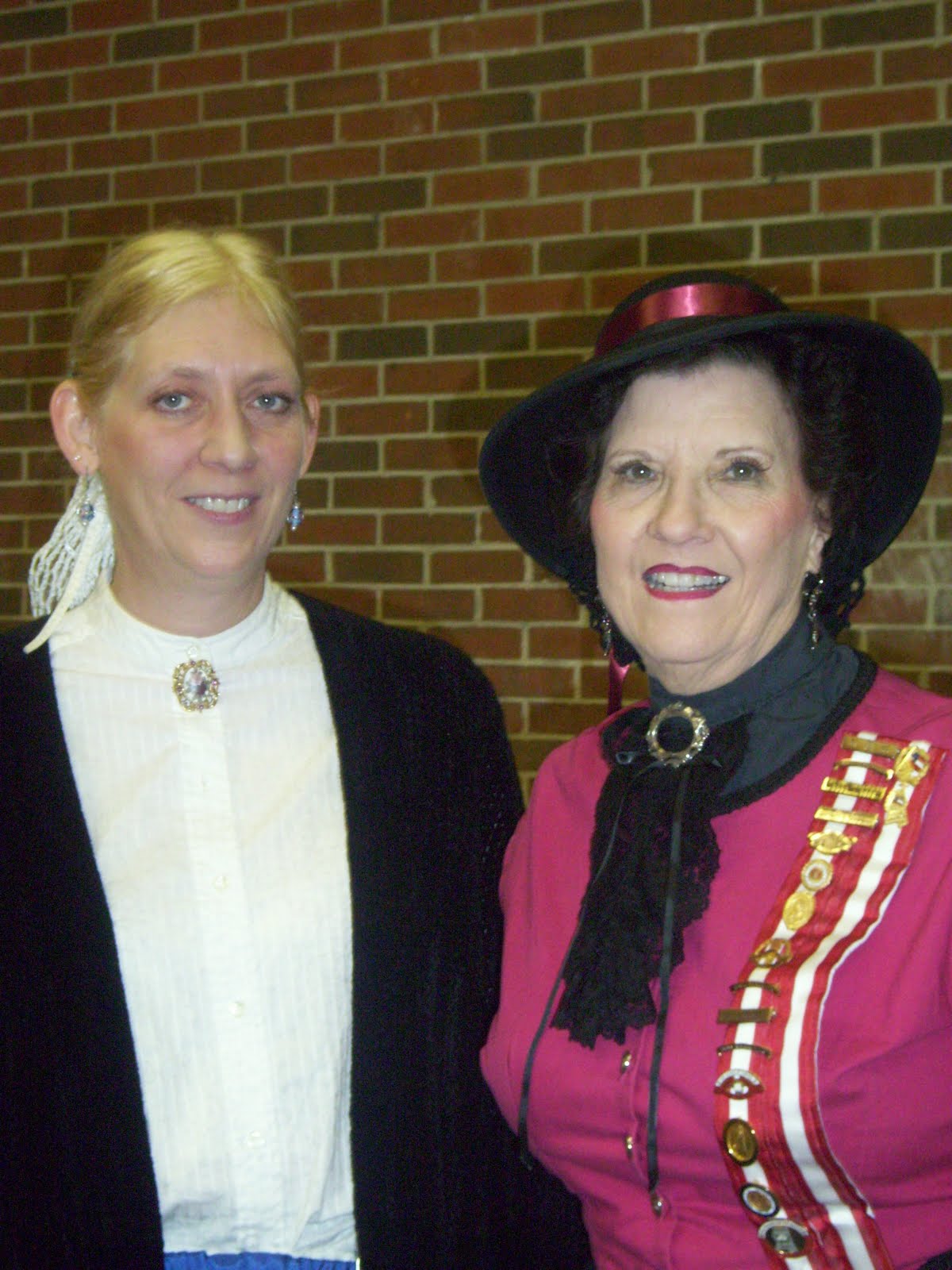
This morning I had the privilege of attending the Horn Lake Library with two of my dear friends, Mr. and Mrs. Lynne Herron, where we gave a presentation about the War Between the States to approximately 200 children. It was a lot of fun, and the kids were great! They were all very well-behaved, attentive, and curious about what people 150 years ago lived like.

Our presentation included performing several Civil War songs. Miss Dorothy talked about our period clothing and the language of the fan. Mr. Lynn discussed what a typical soldier in the army had to endure, and he brought along Civil War paraphernalia for the kids to experience, including a cannon ball, bullets, cooking utensils, and weaponry.

We gave each one of the kids a piece of hardtack. Most said they liked it! The event was the first in a series that we plan to give as living history lessons to local school children, as well as Seniors in Action and other groups.

Monday, January 10, 2011

Secession! Secession! Secession!

As most Civil War buffs know, yesterday was the 150th anniversary of Mississippi's secession from the Union. Today marks the sesquicentennial of Florida's departure, and tomorrow will be the 150th anniversary of Alabama's split from the U.S. government.

The United Daughters of the Confederacy, of which I am a member, will be having a commemorative ceremony in Jackson on the 28th at the War Memorial Building. I am certain that other states will be doing the same thing. Our division is also preparing a special pin in honor of the occasion.

The fervor that consumed the Southern states during that time must have been contagious. Effigies of Lincoln were burned in the streets, speeches were given to inspire the hearts of young warriors, and celebrations resounded. If only they knew what was in store ... so many naive Americans believed that, if the country did go to war, it would be over in 90 days. Four years later, over 164,000 lives were lost, and the course of American history would be changed forever.

Friday, December 17, 2010

UDC Christmas

Last Monday night, my United Daughters of the Confederacy chapter (Varina Howell Davis #2559 in Horn Lake, Mississippi) celebrated Christmas with our annual party. We had a good turnout, and enjoyed lots of great food, friendship, and games! We also participated in a secret Santa gift exchange.

The ladies of the UDC have much to celebrate. This year we participated in the Southaven Christmas parade, and recently learned that our float placed FIRST PLACE! We deserve it after traveling the parade route (4 miles) in frigid Mississippi December weather, over hill and dale, and overcoming a locked vehicle. Fortunately, no one fell down this year!

My chapter also participated in Southern Lights, which is a Southaven tradition. The UDC works one night at the gate each year, and this is one of our primary money makers. It is my understanding that we collected enough to make our goal this year. The Christmas season is indeed a special one when we have so many friends to celebrate it with.

Tuesday, November 23, 2010

UDC National Convention (pt. 5)


Sunday night, November 7, following dinner at the United Daughters of the Confederacy National Convention in Richmond, I managed to contract a stomach virus, and paid for it all night. I learned later that the bug was going around, but at the time, I wasn't sure if it was food poisoning. After suffering for 72 hours, I realized that it wasn't food poisoning after all.

Monday was the final day of the convention, but I spent the entire time in bed while other members voted in new officers. Our Mississippi president was elected national vice president. Fortunately, one of the ladies had an extra bed to provide me before we departed the Omni Hotel on Monday evening and headed back to Charlottesville, spotting several white-tailed deer along the way.

In the morning, we went out for breakfast, departed Lake Monticello, and headed to Appomattox Courthouse. Wilmer McLean's house has been restored, as have several other outbuildings at the tavern, located at a crossroads intersection. The road where Confederate soldiers lined up to surrender their arms still exists. The buildings were in severe decay when restoration began. Mr. McLean lived at the home for five years after the war until his debt forced him to move back to Northern Virginia, where his wife owned a home. From that time until the 1970's, the house and surrounding buildings stood vacant. Restoration is still in process.

We reached Knoxville, where we spent the night, and continued on to Mississippi the following day. Hence, our big trip came to an end. Even though I fell sick, it was still the trip of a lifetime, and I'm glad I went! Thanks to everyone who helped make it happen.

Monday, November 22, 2010

UDC National Convention (pt. 4)


Sunday morning, November 7 was bright and sunny. My group decided to head over to Hollywood Cemetery, where we made a tour for ourselves, taking in the sights. The Confederate monument shaped like a pyramid was awesome, as was seeing the graves of Jeb Stuart, Jefferson Davis and Varina Howell Davis, my chapters' namesake. Somehow we missed Pickett's grave site, but we saw enough old Victorian headstones to make up for it,and the fall colors were brilliant.

We returned to the hotel in time to change and board the bus for a memorial service, which was held at St. Paul's Episcopal Church in Richmond. This church has seen a lot of history in its day ... Jefferson Davis was in a Sunday morning service when a courier delivered the news that Robert E. Lee was pulling his troops from Richmond. Once the service was over, President Davis ordered that the city be evacuated and departed himself later that day. We then continued our tour onto the headquarters of the United Daughters of the Confederacy.

On Sunday evening, we congregated in the large convention hall again for a silent auction, dinner, and entertainment by Doug Lothes, who gave us his interpretation of "Gone With the Wind in 20 Minutes." His performance was absolutely hilarious! He portrayed each of the characters himself while adding his own flair. It was a very fun evening, until ...

Saturday, November 20, 2010

UDC National Convention (pt. 3)


Friday morning, November 5 in Richmond consisted of one meeting after another. I set up shop in the corner of a vendor's table and commenced to selling my novel while enjoying the crowd, as well as the other vendors. The hats were awesome! At lunchtime, the UDC ladies dined on salads and listened to entertainment provided by a local author who portrayed his character.

Following an afternoon of more meetings, we congregated after supper in the large convention hall. Each state who had representatives present at the convention had their flag carried in, whereby the ladies from that state sang their state song. It was very inspirational. After the display, Mrs. Ruth Ann Coski spoke about Varina Howell Davis. I had the opportunity to meet Ms. Coski, and gave her a copy of my novel, A Beckoning Hellfire, to pass on to her husband, John, who assisted me in my writing in research.

On Saturday, the ladies partook in more meetings. My small group of Mississippi Ma'ams found a very cool restaurant down the street, which looked to be as old as Richmond itself, and served the best hamburgers! On Saturday evening, we dressed up and gathered in the large convention hall for the President's Dinner, where live musicians (Civil War era, of course) entertained us.

Thursday, November 18, 2010

UDC National Convention (pt. 2)


My escapades with the UDC ladies continued. On Thursday, November 4, after spending the night in Charlottesville, we traveled on toward Richmond through heavy rainfall, traffic, and ominous darkness. Amazingly, we arrived at the Omni Hotel, checked in to our wonderful room, and made it back downstairs in time to board the tour bus, which took us to the state Capitol Building. A tour guide gave us the insights as to Jefferson Davis' time spent there, as well as many other patriots who resided within its Romanesque-like walls.

Following a quick lunch, we rode the bus to Petersburg, and toured the amazing Blandford Church. Following the Civil War, the infamous Louis Tiffany was commissioned to create stained glass windows for the church, each one representing a state of the Confederacy. Needless to say, the sight was inspiring. We boarded the bus, rode through the ancient cemetery surrounding the church, and embarked back to Richmond, where we toured the Museum of the Confederacy.

I have been to the museum once before, but this time was even more insightful. It's like most things in life: you see it once and you remember certain things, but when you see it again, you absorb so much more. I noticed paintings I hadn't remembered seeing before, and the portrait of General Robert E. Lee was almost spooky, because his eyes seemed to follow me wherever I was in the room! My "partner in crime" persuaded one of the vendors to share their table, and so I was established to sell my novels at a small end corner of one of the tables. Thus began the convention ...

Tuesday, November 16, 2010

UDC National Convention


Last weekend (Nov. 4-9) was the national United Daughters of the Confederacy General convention. This year, the event took place in Richmond, which only seems appropriate, since that city was the capital for the Confederacy during the War Between the States. Over the course of the next several installations, I will discuss the convention, as well as Richmond itself, and all of the amazing history that exists there.

I departed from Mississippi on Tuesday with three other ladies, two of which belong to the Varina Howell Davis chapter of the UDC with me (I am an associate member, but I prefer to refer to myself as an "honorary member"). After a day of driving through Tennessee, we reached the border of Virginia, and immediately, my spirits were lifted. I have only been to Virginia twice before, but every time I go there, I get an overwhelming feeling that I have been there in a previous life. The beauty of the state always awes and inspires me.

After spending the night in Wytheville, we proceeded the next day toward Charlottesville. En route, we traveled the Blue Ridge Parkway, which was amazing, adorned in colorful fall foliage. Some of these photos can attest to the awe-inspiring beauty of the Blue Ridge Mountains.

Tuesday, October 19, 2010

Mississippi State UDC Convention


Recently, I had the privilege of attending the annual Mississippi United Daughters of the Confederacy Convention. This year's event took place in Hattiesburg, which is a lovely town full of history, friendly people, and amazing antebellum homes. The Daughters were originally booked in a hotel that was evacuated because of structural problems, so the convention was moved down the street to another hotel. Needless to say, the event went smoothly after that, and everyone in attendance had a great time.

Thursday, August 26, 2010

They Gave Me a Medal!


Last Saturday night, the United Daughters of the Confederacy Varina Howell Davis Chapter 2559 celebrated its 20th anniversary. A great turnout attended the event, which was held in Hernando, Mississippi. After a delicious dinner, the guests were entertained by members who were decked out in their finest fashions. Needless to say, these over-accessorized ladies proceeded to adorn the vice president and new president's grandmother with their stylings while convincing everyone to join and attend the monthly meetings.

Following a wonderful presentation by Annie Ruth Brown about "not so famous Confederates," two people were bestowed the prestigious Stonewall Jackson medal. I am happy to report that I was one of them! Thank you so much ladies for giving me the honor of participating in your chapter's events during the past year. It has been fun and enlightening, and I have made lifelong friendships. My sincere gratitude and thanks to all of you. I can't wait to see what next year brings!

Tuesday, July 27, 2010

Real Sons and Daughters

It amazes me to think that there are still people out there who can claim that they are "real" sons or daughters of Civil War veterans. According to several recent reports, it is estimated that around 300 real sons and daughters are still alive in the United States. Most of them are now in their nineties, which would make them pretty young when their fathers served. Although they were too young to recollect the war themselves, many can still amuse us with stories they grew up hearing from their parents.

In my UDC chapter, we have one real daughter who is a member. She is, of course, in her eighties, and still lives at home. The chapter members religiously send her birthday cards, gifts at Christmastime, and awards to bestow upon her.

Real sons of the Confederacy are thought to number around 100, real daughters are approximately 150, and Union children number only about 50. A recent story that appeared in the Culpeper, Virginia newspaper, featured a local 93-year-old man named Austin Brown. You can read about him at the following link:

http://www2.starexponent.com/cse/news/local/article/93-year-old_is_son_of_Civil_War_veteran/58861/

My father-in-law, who was a WWII veteran, told some mind-blowing stories, but I was too naive to record them, and now I wish I had. So if any of you know a real son or daughter, take my advice: NOW is the time to get their story!

Tuesday, July 20, 2010

Famous Horses in the War Between the States

Last night I had the privilege of giving a presentation to my UDC chapter on a topic of my choosing. Since I am an avid horse lover, and my novel is about the Confederate cavalry, I decided to speak about famous Civil War horses. The most famous equines are listed below ...

Traveller (Gen. Robert E. Lee) – As a colt, he won 1st prize at a fair in Lewisburg, VA. First named “Jeff Davis” by his owner, Major Thomas Broun, who paid $175 in gold for him, General Lee always referred to him as “my colt.” Lee obtained Traveller in the spring of 1862, purchased him for $200 in currency and changed his name, and the two were seen together almost daily. Lee owned other horses: “Grace Darling,” “Brown Roan,” “Lucy Long,” “Ajax,” and “Richmond,” but all became unserviceable. He was astride Traveller when he rode to the McLean house at Appomattox Court House, and Traveller lived with General Lee at Washington and Lee University after the war. At Lee’s funeral, Traveller marched behind the hearse, his step slow and his head bowed as if he understood the importance of the occasion.

King Philip (Gen. Nathan Bedford Forrest) – This horse charged and snapped his teeth at anyone wearing blue. After the war, King Philip chased off Yankees visiting General Forrest, and while pulling a wagon, went after policemen wearing blue uniforms. One of Forrest’s men noted, “Your negroes fight for you and your horses fight for you.” King Philip died later in 1865 from colic and is depicted at Nathan Bedford Forrest Park. General Forrest also owned “Roderick” and “Highlander,” who was shot in the carotid at Chattanooga. Forrest plugged the hole with his finger until after battle, whereby the horse dropped dead. The general had 29 horses shot out from under him, and is quoted as saying after the war, “I was one horse ahead.”

Cincinnati (Lt. Gen. U.S. Grant) – After the Battle of Chattanooga in 1863, General Grant went to St. Louis, where a man offered to sell him his horse if he promised to take good care of it. Grant accepted, renamed the stallion, and kept him until the horse died in 1878. Cincinnati was the son of Lexington, the fastest four-mile thoroughbred in the U.S., and nearly equaled the speed of his half-brother, Kentucky. Grant was offered $10,000 in gold for him but refused. This fact is profound since Grant was near poverty before he wrote his memoirs. General Grant only permitted two others to ride Cincinnati: President Lincoln and Admiral Daniel Ammen, who had saved his life from drowning when he was a boy. Grant was a horse lover who got along better with horses than he did people and originally wanted to be in the cavalry but was declined. Other horses he owned included Jack, who was with him until after the battle of Chattanooga and which Grant used for special occasions and parades. Grant donated him to the Sanitary Fair in Chicago in 1863-64 where the horse was raffled off and brought $4000 to Sanitary Commission. Grant rode “Fox” at Shiloh, “Kangaroo” at Vicksburg, and also owned “Egypt” and “Jeff Davis,” which in 1864, was captured from Joe Davis’ plantation (Jefferson’s brother).

Daniel Webster (Maj. Gen. George B. McClellan) – This horse was called “that Devil Dan” because of his speed. McClellan owned the horse from 1862 until after the war, and the animal died at age 23. McClellan said of his beloved steed, “No soldier ever had a better horse than I had in Daniel Webster.” The general, who invented the McClellan saddle, also owned “Black Burns” and “Kentuck.”

Highfly (Maj. Gen. JEB Stuart) –In the summer of 1862, Stuart was stretched out on a bench on the porch of a tavern waiting for General Fitzhugh Lee to arrive, but the Yankees arrived first. Stuart narrowly escaped on Highfly, but his hat with the long ostrich plume was captured. General Stuart also owned Virginia, a warm-blooded mare who saved Stuart from capture when he invaded Pennsylvania by leaping over a wide gulley and escaping capture.

Old Sorrel (Gen. Stonewall Jackson) – This mare was also known as “Little Sorrel” because she was so small that when Jackson was mounted, his feet almost touched the ground. He obtained her on May 1, 1861 while in command of the garrison at Harper’s Ferry when a train with supplies for Union troops was captured. She was then thought to be 11 years old. In 1884, Old Sorrel appeared at a state fair in Hagerstown, Maryland, where almost all her mane and tail hair was plucked out by souvenir hunters. When she died, she was stuffed, and is now at the Solder’s Home in Richmond.

Winchester (Gen. Philip Sheridan) – Originally named “Rienzi,” he was given to then Colonel Sheridan in the spring of 1862 while Sheridan was stationed at Rienzi, Mississippi, but the horse’s name wasn’t changed until after Sheridan’s famous ride to Winchester in the Battle of Cedar Creek on Oct. 19, 1864. Winchester was so revered that when he died, he was stuffed and given to the Smithsonian Institution. Sheridan also owned “Alderbaron” prior to Winchester.

Baldy (Brig. Gen.George Meade) – The horse was with him at 1st Bull Run (wounded twice) and Antietam, where he was left for dead but later discovered grazing with a deep wound in his neck. He was also at Fredericksburg, Chancellorsville, and Gettysburg, where he received a bullet lodged between his ribs. Meade kept him with the army until the following spring, then sent him to pasture in Pennsylvania. After the war, Meade retrieved his charger, fully recovered, and the two became inseparable. Baldy followed Meade’s hearse, lived 10 more years, and upon his death, his head and two fore hoofs were mounted and are now cherished relics of the George G. Meade Post, Grand Army of the Republic in Philadelphia.

Lexington (Gen. William T. Sherman) – This horse was a Kentucky thoroughbred who attracted admiration due to his fine form. Sherman was astride Lexington when he entered Atlanta, and following the war in 1865, rode him in final Grand Review in Washington. Sherman also owned Sam, a half-thoroughbred bay that made one of the longest and most difficult marches ever recorded in history from Vicksburg to Washington. He died of extreme old age in 1884.

Moscow (Maj. Gen. Philip Kearny) – This was a white horse that made the general very conspicuous during battle, so he switched to a bay named “Decatur” and then to “Bayard.”

Other Famous Horses include:
Lookout (Maj. Gen. Joseph Hooker) – obtained in Chattanooga and named after a battle that took place there
Almond Eye (Maj. Gen. Benjamin Butler)
Nellie Gray (Maj. Gen. Fitzhugh Lee)
Billy (Maj. Gen. George Thomas) named after his friend, General William T. Sherman
Fleeter (Belle Boyd)
Dixie (Maj. Gen. Patrick Cleburne) – killed at Perryville – Cleburne was killed at Franklin, Tennessee
Rifle (Lt. Gen. Richard Ewell)
Beauregard (Capt. W.I. Rasin) - ridden by Rasin to Appomattox and survived until 1883
Black Hawk (Maj. Gen. William Bate)
Fire-eater (Gen. Albert Johnston)
Old Fox (Col. E.G. Skinner)
Slasher (Maj. Gen. John Logan)
Boomerang (Col. John McArthur)

Thursday, July 15, 2010

More on Nathan Bedford Forrest


Last Sunday, local SCV camp and UDC chapter members gathered together at Nathan Bedford Forrest Park in Memphis to celebrate the illustrious general's birthday. This celebration has been marked every year, sometimes with noted speakers such as Shelby Foote, Jeff Shaara, and last year, Bertram Hayes-Davis, Jefferson Davis' great grandson.

This year's speaker was Judge Melvin McClure, who enlightened the crowd with his topic about General Forrest's horses. The general had 29 horses shot out from under him, and is quoted as saying he was one horse ahead (meaning he killed 28 Yankees). The first battle where General Forrest lost his mounts (2) was at Dover, Tennessee in February 1863, and the last horse killed was at Selma, Alabama in April 1865. At the battle of Chattanooga, "Highlander" received a fatal wound to his carotid artery. General Forrest plugged the hole with his finger until after the battle, whereby the horse immediately died.

Judge McClure's most amusing story was that of "King Phillip," a white horse with a dark mane and tail. This spirited animal hated the sight of anything in blue, and reportedly snorted, bolted, and snapped his teeth in the air while charging toward the Federals. One soldier told the general, "Your negroes fight for you and your horses fight for you." After the war, General Forrest was riding in a wagon which was being pulled by King Phillip, who saw police officers in blue. To the general's chagrin, the horse immediately charged after them, embarrassing his master. Sadly, King Phillip died of colic later that year. He is represented as a statue, standing regally with his master atop, in Nathan Bedford Forrest Park, which is represented in the above photos.

Tuesday, July 13, 2010

Happy Birthday General Forrest


Nathan Bedford Forrest was born on this date in 1821. In his honor, a large gathering of local Sons of Confederate Veterans and United Daughters of the Confederacy took part in a celebration ceremony at Nathan Bedford Forrest Equestrian Park in Memphis, Tennessee. There were many spectators on hand, and members of the Children of the Confederacy bestowed wreaths and Confederate flags at the base of the general's statue.

A large display of flags adorned the grounds, as did many wreaths, and the crowd was entertained by several speakers and members of the 52nd Regimental String Band, who performed a few period songs.

A Benediction and musket salute wrapped up the ceremony. I will write more about the event later this week, as well as Nathan Bedford Forrest's lasting impact, particularly in the Memphis region.

Monday, June 21, 2010

SCV Members Support Their Community


Last Friday night was the opening performance of "Shenandoah," a musical about the Civil War. It is being presented by The Desoto Civic Center, a theater here in Mississippi. To support the show, a local chapter of the Sons of Confederate Veterans attended, and more members will see the play while it shows this week, along with an area chapter of the United Daughters of the Confederacy.

The SCV generously donated their uniforms for use as costumes to the cast, along with relics and a cannon. This might not seem like a huge gesture, but when you consider how much they invest in their uniforms, not to mention all the extras like shoes, canteens, etc., it really adds up. Needless to say, the cast is now decked out in very authentic duds!

This is just one example of how local chapters contribute to their communities. I urge all of you to support your local chapters if you can. There is so much negativity attached to the Confederacy now that generosity such as this is often overlooked. The SCV, as well as the UDC, do much to inform and support their heritage.

Sunday, June 6, 2010

Confederate Decoration Day


This afternoon an inspiring event took place in Memphis. A large group of historians, reenactors, and spectators gathered at the Soldiers’ Rest in historic Elmwood Cemetery, where they paid homage to their ancestors. Known as Confederate Decoration Day, the event was attended by over sixty people.

The United Daughters of the Confederacy sponsored the occasion. Following a welcome, greeting, and invocation by Tennessee division chapter members, the audience was asked to participate in saluting flags, including the American Flag, the Christian Flag, the Flag of Tennessee, and the Confederate Flag. A wreath presentation came next, followed by music performed by the 52nd Regimental Band, who entertain at many local Civil War events.

Donald Harrison, past Commander of the Robert E. Lee SCV camp in Shelby County, gave a wonderful speech discussing why Confederate soldiers fought, why they should not be considered traitors, and why we should honor them by not questioning their motives, as things were quite different 150 years ago, just as ideals will be very different 150 years from now. After a special presentation to a local author, the Children of the Confederacy decorated the Confederate Monument with a bouquet of red roses. Morton’s Battery and the 51st Tennessee Infantry Regiment gave a musket salute, firing off three rounds to the spectators’ enthrallment.

It is events like this that keep the memory of our ancestors alive. Without them, fallen heroes and departed veterans will be lost to history. Although the Civil War is becoming more distant with each passing year, it is still relevant, and extremely important that we pay homage, or it will be forgotten forever. This is what could become of our blessed veterans to future generations: WWI and WWII vets could become extinct to memory, as well as Korean, Vietnam, and more recent battle-scarred soldiers. It has happened with the Revolutionary War, and it is happening with the War Between the States, because assumptions and simplifications have been made about the war’s motives. Let us always pay honor, lest we forget.