Showing posts with label War Between the States. Show all posts

Thursday, January 20, 2011

UDC/SCV Represented at Local Library


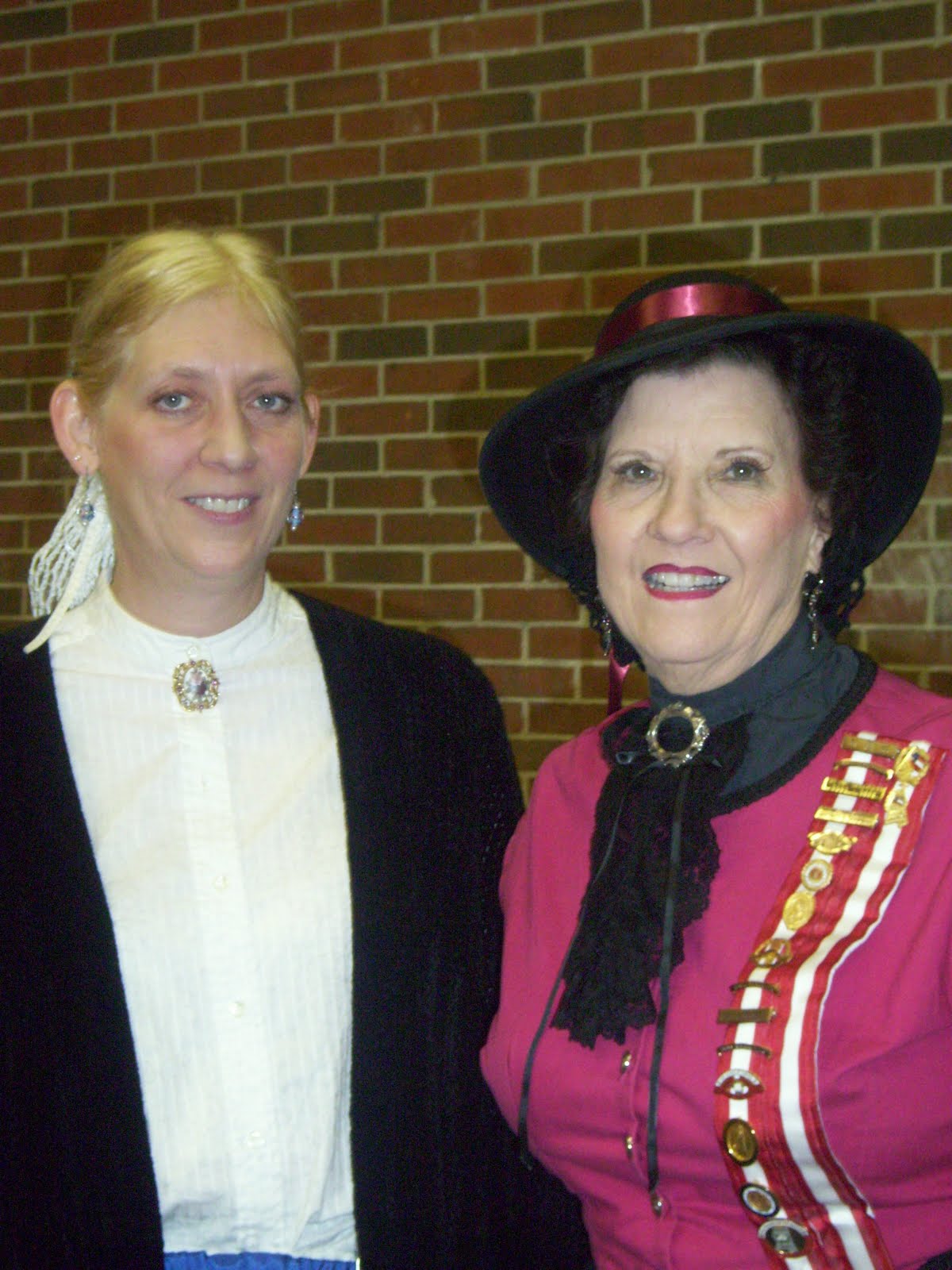
This morning I had the privilege of attending the Horn Lake Library with two of my dear friends, Mr. and Mrs. Lynne Herron, where we gave a presentation about the War Between the States to approximately 200 children. It was a lot of fun, and the kids were great! They were all very well-behaved, attentive, and curious about what people 150 years ago lived like.

Our presentation included performing several Civil War songs. Miss Dorothy talked about our period clothing and the language of the fan. Mr. Lynn discussed what a typical soldier in the army had to endure, and he brought along Civil War paraphernalia for the kids to experience, including a cannon ball, bullets, cooking utensils, and weaponry.

We gave each one of the kids a piece of hardtack. Most said they liked it! The event was the first in a series that we plan to give as living history lessons to local school children, as well as Seniors in Action and other groups.

Monday, January 10, 2011

Secession! Secession! Secession!

As most Civil War buffs know, yesterday was the 150th anniversary of Mississippi's secession from the Union. Today marks the sesquicentennial of Florida's departure, and tomorrow will be the 150th anniversary of Alabama's split from the U.S. government.

The United Daughters of the Confederacy, of which I am a member, will be having a commemorative ceremony in Jackson on the 28th at the War Memorial Building. I am certain that other states will be doing the same thing. Our division is also preparing a special pin in honor of the occasion.

The fervor that consumed the Southern states during that time must have been contagious. Effigies of Lincoln were burned in the streets, speeches were given to inspire the hearts of young warriors, and celebrations resounded. If only they knew what was in store ... so many naive Americans believed that, if the country did go to war, it would be over in 90 days. Four years later, over 164,000 lives were lost, and the course of American history would be changed forever.

Monday, December 27, 2010

New Discoveries for the New Year

This week, two interesting news stories broke in regard to the War Between the States. It was announced that descendants of John Wilkes Booth are exhuming his brother's body in order to obtain DNA. It will then be compared to the person thought to be buried as John Wilkes Booth. Speculation has circulated since his death (he was shot in a barn two weeks after assassinating President Abraham Lincoln) that an impostor was actually shot, and that the real JWB escaped and lived until 1903, when he committed suicide in Enid, Oklahoma under the assumed name of John St. Helen. Theories exist that he was a member of the Knights of the Golden Circle, an elite group of Confederates who concealed Booth's identity and assisted in his escape.
http://www.aolnews.com/2010/12/23/did-abraham-lincoln-assassin-john-wilkes-booth-escape-dna-may-s/


Another discovery concerns a message in a bottle. The find was given to the Museum of the Confederacy in Richmond, Virginia in 1896. It was a gift from Capt. William A. Smith, of King George County, who served during the Vicksburg siege. The message, dated July 4, 1863, was encrypted, and the curator of the museum finally became curious enough to find out what was inside the tiny 2" bottle. Essentially, the author, who is believed to have been Maj. Gen. John G. Walker, of the Texas Division, and who had under his command William Smith, the donor of the bottle, stated that he was unable to provide support to General Pemberton, the Confederate General who was under siege in Vicksburg, Mississippi. It was on that same day that the Confederate army surrendered to Ulysses S. Grant's Union forces.
http://www.aolnews.com/2010/12/25/civil-war-message-in-a-bottle-opened-decoded/?icid=main|htmlws-main-n|dl1|sec1_lnk3|192058

Sunday, November 28, 2010

Another Fascinating Discovery

Recently, a site relating to the War Between the States was discovered in Georgia. This time, it was a Confederate prison used for Union POW's. The prison was occupied for a short time before closing in 1864, when prisoners were relocated to South Carolina to avoid Sherman's "March to the Sea."

Specifically, the camp, which was referred to as "Camp Lawton" because it was near Lawton, Georgia, replaced Andersonville in the fall of 1864. The camp was just as foul, and was only used for six weeks. During that time, approximately 725 to 1,330 men perished. The number is unknown because the deceased were tossed into a mass grave, which the Union soldiers discovered in December 1864. Only a board beside a freshly-dug plot, stating "650 buried here," marked their remains. Enraged, Union troops burned the prison to the ground, as well as a hotel and depot in nearby Millen. No photo exists of the camp, but a Union mapmaker named Private Robert Knox Sneden painted watercolor pictures and kept a journal detailing life in Lawton while he was imprisoned there.

The site was lost for nearly 150 years, but was discovered by Georgia Southern University students who were exploring a state park and federal fish hatchery in Lawton. They found prisoners' personal artifacts such as silverware and coins, as well as the exact location of the prison's stockade. Archeologists have proclaimed that the find is "one of the most significant Civil war discoveries in decades."

Tuesday, November 16, 2010

UDC National Convention


Last weekend (Nov. 4-9) was the national United Daughters of the Confederacy General convention. This year, the event took place in Richmond, which only seems appropriate, since that city was the capital for the Confederacy during the War Between the States. Over the course of the next several installations, I will discuss the convention, as well as Richmond itself, and all of the amazing history that exists there.

I departed from Mississippi on Tuesday with three other ladies, two of which belong to the Varina Howell Davis chapter of the UDC with me (I am an associate member, but I prefer to refer to myself as an "honorary member"). After a day of driving through Tennessee, we reached the border of Virginia, and immediately, my spirits were lifted. I have only been to Virginia twice before, but every time I go there, I get an overwhelming feeling that I have been there in a previous life. The beauty of the state always awes and inspires me.

After spending the night in Wytheville, we proceeded the next day toward Charlottesville. En route, we traveled the Blue Ridge Parkway, which was amazing, adorned in colorful fall foliage. Some of these photos can attest to the awe-inspiring beauty of the Blue Ridge Mountains.

Sunday, October 31, 2010

Halloween Haunts (pt. 3 )


Most people think of cemeteries and battlefields when they hear about strange apparitions that exist in regard to the Civil War. However, many old fortresses are rumored to host the spirits of soldiers past as well. As my final installation of "Halloween Haunts," I bring to you the forts that time forgot.

Fort Delaware, located in Delaware City, Delaware, is an imposing structure that is said to be one of the most haunted places in America. It is no wonder, considering the suffering that took place during the War Between the States. The fort unintentionally became a prisoner of war camp, with most of its inhabitants being captured at the Battle of Gettysburg in 1863. The fort, located on six acres, with 32 foot high walls and surrounded by a medieval moat, housed over 40,000 men by war's end. The fort had the highest mortality rate of any POW camp: 2500 to 3000 men died. The ghosts of incarcerated Confederates still inhabit the place, as does a woman and several children. Across the river is Finn’s Point National Cemetery, where most of the Confederate soldiers are buried. Sadly, only one marker is placed, which reads, "Erected By The United States To Mark The Burial Place Of 2436 Confederate Soldiers Who Died At Fort Delaware While Prisoners Of War And Whose Graves Cannot Now Be Individually Identified."

Fort Monroe, where President Jefferson Davis was imprisoned following his capture after the fall of the Confederacy, is another ominous place that seethes with spiritual energy. Located in Virginia, which ranks as the most haunted place in America according to the National Register of Haunted Locations, the fort has reported many spiritual sightings, including those of Abraham Lincoln and General U.S. Grant.

Off the gulf coast of Alabama exists two ancient forts that have now become tourist attractions: Fort Morgan and Fort Gaines. Both forts have a long history of military service, surviving many wars, and not surprisingly, both have their share of supernatural inhabitants. Visitors have reported hearing footsteps, seeing strange apparitions that follow them out of the park areas, and noticing ghosts that observe them while they are there.

Thursday, October 21, 2010

October Remembrances

This week marks the anniversaries of two significant battles that took place during the War Between the States. Tuesday was the anniversary of the Battle of Cedar Creek (1864), and today was the anniversary of the Battle of Ball's Bluff (1861). Both of these battles took place in Virginia.

The Battle of Ball's Bluff was the second largest battle to take place in 1861. The battle resulted in a victory for the Confederates, and led to the establishment of the Congressional Joint Committee on the Conduct of the War after controversy arose as to whether Union officials were participating in a conspiracy against the U.S. government.

At the Battle of Cedar Creek three years later, the Confederacy suffered a crushing blow when General Jubal Early attempted to attack Washington but failed. The defeat led to Abraham Lincoln's reelection, and prevented the Confederates from ever being able to invade Washington again or protect the economic base in the Shenandoah Valley. General Sheridan rode to fame when his cavalry came to the rescue of the Union Army, and his ride is immortalized in Thomas Buchanan Read's famous poem entitled "Sheridan's Ride."

With next year marking the 150th anniversary of the Civil War, it is without a doubt that much celebration will take place in Virginia, especially on October 21, which will be the sesquicentennial anniversary of the Battle of Ball's Bluff.

Thursday, September 16, 2010

Another Anniversary

Tomorrow marks the 148th anniversary of the Battle of Antietam, infamously known as the bloodiest single day of the Civil War. The battle took place near Sharpsburg, Maryland and Antietam Creek. Southerners refer to the battle by the town,whereas Northerners refer to it by the creek. The battle claimed 23,000 casualties. General McClellan confronted General Lee after the Confederates gained control of Harper's Ferry, Virginia two days prior (the anniversary of this event happened yesterday).

Among several remarkable landmarks that still exist at this battlefield site are the "Sunken Road," "Dunker Church," and "Burnside Bridge," where the fighting was so heavy that dying soldiers on the bridge bloodied the creek beneath until the water ran red. The battle was ultimately declared a draw, but President Lincoln saw it as an opportunity to publicly announce his Emancipation Proclamation, which became law the following January in 1863. Regardless, the battle also led to McClellan's dismissal as Major General of the Army of the Potomac.

The National Park Service has announced several free admission dates, which include the Antietam National Military Park. Upcoming dates are next Saturday, September 25, and November 11, which is Veterans' Day. I encourage everyone to take advantage of this opportunity. Antietam is a national treasure, and once you see it, you will forever be impressed.

Thursday, September 9, 2010

Confederates Receive Honor in England with Grave Markers

Although places in America are protesting the public display of Confederate markers, flags, etc., the exact opposite seems to be happening in Great Britain. According to a recent issue of the Confederate Veteran magazine, a senior Sons of Confederate Veterans member visited Britain only to discover that the country had honored fallen soldiers by placing Confederate flags on their graves. There are several thousand Confederate veterans buried in Britain, as well as in nearly every other country throughout the world.

During the War Between the States, there was a profound connection between England and the South of which we will probably never know the exact proportion. It is estimated that 200,000 British-born soldiers fought on both sides, and that 141,000 of the South's citizens were born in the British Isles.

There are over 1,000 Confederate reenactors and two SCV camps existing in Britain at present. It seems British officials are far more supportive about Confederate events and activities, and recently flew a Confederate flag over a government building: the first time since 1865. This is in sharp contrast to what the U.S. is experiencing. In Richmond last year, an article ran that blatantly proclaimed Southern ancestors who fought for the Confederacy to be "terrorists." Unfortunately, nary an SCV member complained, but members in England did voice their protest. In Great Britain, it is considered a privilege to honor those brave ancestors who fought for Southern independence.

Friday, August 20, 2010

Confederacy Reflected on Six States' Flags

Following the Civil War, it was decided that each state should have a flag to represent itself, so in the late 1880's the process began. Not surprisingly, many southern states chose to represent themselves with replicas of their beloved, albeit lost, Confederacy. Over the course of time, criticism and controversy have surrounded these states' decisions, claiming that they are racist. The motto "Heritage Not Hate," has received skepticism as to its sincerity, and whether it is a cover-up for racism underneath.

Alabama's state flag is white with a red saltire cross, similar in design to the most recognizable flag of the Confederacy, the St. Andrews cross, otherwise known as the Southern Cross. Florida also has a red saltire cross on its state flag. Mississippi has the only state flag that still bears the true replica of the Southern Cross. This design is in the upper left-hand corner, with the rest of the flag resembling the Stars and Bars. North Carolina also has a state flag that resembles the Stars and Bars, as does Texas, and Tennessee's flag replicates the battle flag by its color scheme and design with a vertical bar on the fly that is reminiscent of the Stainless Banner. Two other states use similar colors in their flag designs: Arkansas and Missouri. Georgia received so much flack that it underwent numerous changes until finally deciding on a design that displays previous state flags.

It is fascinating to see how some state's flags transformed over the years. Texas and Florida both started out with the Bonnie Blue Flag. Interestingly, California also had a lone star flag, although it was considered to be a part of the Union during the War Between the States.

Monday, August 9, 2010

Civil War Battle Anniversaries


Today and tomorrow mark the anniversaries of two significant battles that transpired during the War Between the States. On this date in 1862, the Battle of Cedar Mountain took place, and August 10 marks the 149th anniversary of the Battle of Wilson's Creek.

The Battle of Cedar Mountain took place in Culpeper County, Virginia. Culpeper changed hands between Union and Confederate forces 78 times over the course of the war. Also known as Cedar Run and Slaughter's Mountain, the battle was the first combat to take place in the Northern Virginia campaign, resulting in a Confederate victory led by General Stonewall Jackson. Union casualties were 2,353: Confederate casualties totaled 1,338.

At the Battle of Wilson's Creek, also known as the Battle of Oak Hills, the Missouri State Guard took on attacking Union forces near Springfield. Referred to as "Bull Run of the West," this battle is considered to be the first major conflict west of the Mississippi River, resulting in a Confederate victory. Casualties were nearly equal on both sides: 1,317 Union and 1,230 Confederate. The battlefield is in nearly pristine condition today, hardly changed from how it appeared in 1861, unlike many tainted battlefields in the east.

Tuesday, August 3, 2010

Riverboats and the Civil War


It is a well-known fact that riverboats were essential to Southern commerce before and during the War Between the States. Southern states used rivers to transport cotton to the north, and one of the most heavily-used rivers was the Mississippi. Old Man River took his share, as there are still many riverboats sunken into the silt of the mighty, muddy Father of Waters.

The Union Army's primary objective in the Western Theatre was to secure the Mississippi, thus strangling the Confederacy's ability to trade and ship wares to various states below the Mason-Dixon Line. By the middle of 1863, the Yankees had accomplished this feat by capturing Vicksburg.

At the end of the war, riverboats were used extensively to transport released prisoners. One such boat, the Sultana, has virtually been lost to history, but her story is fascinating. Overloaded to around 2,400, with a maximum capacity allowance of only 376, the boat chugged her way up the Mississippi until it reached Memphis. A few hours later, as she made her way to Cairo, Illinois, carrying POW's from Andersonville and Catalpa prisons, she exploded. Only a few hundred survived. Known as the worst maritime disaster in North American history, all that remains are a few markers, one of which is located at Elmwood Cemetery in Memphis.

Tuesday, July 20, 2010

Famous Horses in the War Between the States

Last night I had the privilege of giving a presentation to my UDC chapter on a topic of my choosing. Since I am an avid horse lover, and my novel is about the Confederate cavalry, I decided to speak about famous Civil War horses. The most famous equines are listed below ...

Traveller (Gen. Robert E. Lee) – As a colt, he won 1st prize at a fair in Lewisburg, VA. First named “Jeff Davis” by his owner, Major Thomas Broun, who paid $175 in gold for him, General Lee always referred to him as “my colt.” Lee obtained Traveller in the spring of 1862, purchased him for $200 in currency and changed his name, and the two were seen together almost daily. Lee owned other horses: “Grace Darling,” “Brown Roan,” “Lucy Long,” “Ajax,” and “Richmond,” but all became unserviceable. He was astride Traveller when he rode to the McLean house at Appomattox Court House, and Traveller lived with General Lee at Washington and Lee University after the war. At Lee’s funeral, Traveller marched behind the hearse, his step slow and his head bowed as if he understood the importance of the occasion.

King Philip (Gen. Nathan Bedford Forrest) – This horse charged and snapped his teeth at anyone wearing blue. After the war, King Philip chased off Yankees visiting General Forrest, and while pulling a wagon, went after policemen wearing blue uniforms. One of Forrest’s men noted, “Your negroes fight for you and your horses fight for you.” King Philip died later in 1865 from colic and is depicted at Nathan Bedford Forrest Park. General Forrest also owned “Roderick” and “Highlander,” who was shot in the carotid at Chattanooga. Forrest plugged the hole with his finger until after battle, whereby the horse dropped dead. The general had 29 horses shot out from under him, and is quoted as saying after the war, “I was one horse ahead.”

Cincinnati (Lt. Gen. U.S. Grant) – After the Battle of Chattanooga in 1863, General Grant went to St. Louis, where a man offered to sell him his horse if he promised to take good care of it. Grant accepted, renamed the stallion, and kept him until the horse died in 1878. Cincinnati was the son of Lexington, the fastest four-mile thoroughbred in the U.S., and nearly equaled the speed of his half-brother, Kentucky. Grant was offered $10,000 in gold for him but refused. This fact is profound since Grant was near poverty before he wrote his memoirs. General Grant only permitted two others to ride Cincinnati: President Lincoln and Admiral Daniel Ammen, who had saved his life from drowning when he was a boy. Grant was a horse lover who got along better with horses than he did people and originally wanted to be in the cavalry but was declined. Other horses he owned included Jack, who was with him until after the battle of Chattanooga and which Grant used for special occasions and parades. Grant donated him to the Sanitary Fair in Chicago in 1863-64 where the horse was raffled off and brought $4000 to Sanitary Commission. Grant rode “Fox” at Shiloh, “Kangaroo” at Vicksburg, and also owned “Egypt” and “Jeff Davis,” which in 1864, was captured from Joe Davis’ plantation (Jefferson’s brother).

Daniel Webster (Maj. Gen. George B. McClellan) – This horse was called “that Devil Dan” because of his speed. McClellan owned the horse from 1862 until after the war, and the animal died at age 23. McClellan said of his beloved steed, “No soldier ever had a better horse than I had in Daniel Webster.” The general, who invented the McClellan saddle, also owned “Black Burns” and “Kentuck.”

Highfly (Maj. Gen. JEB Stuart) –In the summer of 1862, Stuart was stretched out on a bench on the porch of a tavern waiting for General Fitzhugh Lee to arrive, but the Yankees arrived first. Stuart narrowly escaped on Highfly, but his hat with the long ostrich plume was captured. General Stuart also owned Virginia, a warm-blooded mare who saved Stuart from capture when he invaded Pennsylvania by leaping over a wide gulley and escaping capture.

Old Sorrel (Gen. Stonewall Jackson) – This mare was also known as “Little Sorrel” because she was so small that when Jackson was mounted, his feet almost touched the ground. He obtained her on May 1, 1861 while in command of the garrison at Harper’s Ferry when a train with supplies for Union troops was captured. She was then thought to be 11 years old. In 1884, Old Sorrel appeared at a state fair in Hagerstown, Maryland, where almost all her mane and tail hair was plucked out by souvenir hunters. When she died, she was stuffed, and is now at the Solder’s Home in Richmond.

Winchester (Gen. Philip Sheridan) – Originally named “Rienzi,” he was given to then Colonel Sheridan in the spring of 1862 while Sheridan was stationed at Rienzi, Mississippi, but the horse’s name wasn’t changed until after Sheridan’s famous ride to Winchester in the Battle of Cedar Creek on Oct. 19, 1864. Winchester was so revered that when he died, he was stuffed and given to the Smithsonian Institution. Sheridan also owned “Alderbaron” prior to Winchester.

Baldy (Brig. Gen.George Meade) – The horse was with him at 1st Bull Run (wounded twice) and Antietam, where he was left for dead but later discovered grazing with a deep wound in his neck. He was also at Fredericksburg, Chancellorsville, and Gettysburg, where he received a bullet lodged between his ribs. Meade kept him with the army until the following spring, then sent him to pasture in Pennsylvania. After the war, Meade retrieved his charger, fully recovered, and the two became inseparable. Baldy followed Meade’s hearse, lived 10 more years, and upon his death, his head and two fore hoofs were mounted and are now cherished relics of the George G. Meade Post, Grand Army of the Republic in Philadelphia.

Lexington (Gen. William T. Sherman) – This horse was a Kentucky thoroughbred who attracted admiration due to his fine form. Sherman was astride Lexington when he entered Atlanta, and following the war in 1865, rode him in final Grand Review in Washington. Sherman also owned Sam, a half-thoroughbred bay that made one of the longest and most difficult marches ever recorded in history from Vicksburg to Washington. He died of extreme old age in 1884.

Moscow (Maj. Gen. Philip Kearny) – This was a white horse that made the general very conspicuous during battle, so he switched to a bay named “Decatur” and then to “Bayard.”

Other Famous Horses include:
Lookout (Maj. Gen. Joseph Hooker) – obtained in Chattanooga and named after a battle that took place there
Almond Eye (Maj. Gen. Benjamin Butler)
Nellie Gray (Maj. Gen. Fitzhugh Lee)
Billy (Maj. Gen. George Thomas) named after his friend, General William T. Sherman
Fleeter (Belle Boyd)
Dixie (Maj. Gen. Patrick Cleburne) – killed at Perryville – Cleburne was killed at Franklin, Tennessee
Rifle (Lt. Gen. Richard Ewell)
Beauregard (Capt. W.I. Rasin) - ridden by Rasin to Appomattox and survived until 1883
Black Hawk (Maj. Gen. William Bate)
Fire-eater (Gen. Albert Johnston)
Old Fox (Col. E.G. Skinner)
Slasher (Maj. Gen. John Logan)
Boomerang (Col. John McArthur)

Tuesday, July 13, 2010

Happy Birthday General Forrest


Nathan Bedford Forrest was born on this date in 1821. In his honor, a large gathering of local Sons of Confederate Veterans and United Daughters of the Confederacy took part in a celebration ceremony at Nathan Bedford Forrest Equestrian Park in Memphis, Tennessee. There were many spectators on hand, and members of the Children of the Confederacy bestowed wreaths and Confederate flags at the base of the general's statue.

A large display of flags adorned the grounds, as did many wreaths, and the crowd was entertained by several speakers and members of the 52nd Regimental String Band, who performed a few period songs.

A Benediction and musket salute wrapped up the ceremony. I will write more about the event later this week, as well as Nathan Bedford Forrest's lasting impact, particularly in the Memphis region.

Thursday, July 8, 2010

The Civil War in Missouri


On a recent trip through the Midwest, my spouse and I stumbled upon a significant battlefield near Springfield, Missouri. The Battle of Wilson's Creek, also known as Oak Hills, took place on August 10, 1861. The Union army overran the Confederates in an attempt to take "Bloody Hill," where Union General Lyon was killed. Losses totaled 1,317 for the Federals, and 1,222 for the Confederates.

According to the park ranger, next year's 150th anniversary reenactment promises to be an astounding event, with over 4,000 reenactors participating. The Battle of Wilson's Creek introduced Missouri to the War Between the States. Over the course of the next three and a half years, Missouri experienced fierce fighting (mostly in the form of guerrilla warfare), since it was a border state, and both sides sought control.

By the end of the war, Missouri had witnessed so many battles that it ranks third as the most fought-over state in the nation. The top two are Virginia and Tennessee, respectively.

Monday, July 5, 2010

Gettysburg and the Definition of "Shoddy"

One of the most infamous battles of the Civil War took place in Gettysburg, Pennsylvania on July 1-3, 1863. Several factors came into play, determining the location of this decisive battle. While General Lee led his Confederate army into enemy territory in an attempt to intimidate Union troops, invade the north, and impede upon Washington, the Rebel army was also in desperate need of shoes. It just so happens that there was a shoe factory in Gettysburg. So hence, the Confederates came in search of shoes, and yet found so much more - most likely what they realized they didn't bargain for.

The Civil War introduced mass production to America. Northern cities began constructing various clothing items, Bibles, and ammunition in mass quantities to supply the Union army. Within months of the war's start, manufacturing was changed forever. Child labor was commonplace, as were sewing factories, where women worked from 12-16 hours a day. Because there was such a high demand for these products, the advent of "shoddy" commenced.

Uniforms supplied to the Federal army were rapidly stitched together in a frantic attempt to keep up with the War Department's demand to supply troops. In 1861, 75,000 men volunteered to fight for the Union army, but the War Department only had enough uniforms for 13,000. Even though the infantry wore out shoes faster than what could be manufactured at the beginning of the war, within months, clothing companies found ways to keep up with demand, and managed to supply the Union army until the end of the war. This was far superior to that of the Confederacy, which was unable to supply its troops with clothing. Therefore, many new recruits enlisted wearing only their own homespun garments.

Wednesday, June 9, 2010

June 9 is Cavalry Day!

Today marks the anniversary of the largest, most famous cavalry battle to ever take place on North American soil, which happened during the War Between the States at Brandy Station, Virginia in 1863. The flamboyant J.E.B. Stuart and his boys were confronted by the enemy in a surprise attack. After clashing, capturing several Union guns, and chasing their adversaries off, the Rebels came out victorious, although they were greatly surprised and outnumbered. This event lead up to the great battle of Gettysburg. In my novel, A Beckoning Hellfire, I discuss the Battle of Brandy Station at length, and explain the events the happened before and after, such as three Grand Reviews that General Stuart staged prior to the attack.

Another cavalry battle took place at Brice's Crossroads, Mississippi, on June 10, 1864, where the infamous General Nathan Bedford Forrest outflanked and outmaneuvered (as usual) his foe. The battle marked another significant achievement in the Western Theatre, as General Forrest outfoxed nearly twice as many opponents. His genius has been a subject of study ever since, and was used by the German's during WWII.

Sunday, June 6, 2010

Confederate Decoration Day


This afternoon an inspiring event took place in Memphis. A large group of historians, reenactors, and spectators gathered at the Soldiers’ Rest in historic Elmwood Cemetery, where they paid homage to their ancestors. Known as Confederate Decoration Day, the event was attended by over sixty people.

The United Daughters of the Confederacy sponsored the occasion. Following a welcome, greeting, and invocation by Tennessee division chapter members, the audience was asked to participate in saluting flags, including the American Flag, the Christian Flag, the Flag of Tennessee, and the Confederate Flag. A wreath presentation came next, followed by music performed by the 52nd Regimental Band, who entertain at many local Civil War events.

Donald Harrison, past Commander of the Robert E. Lee SCV camp in Shelby County, gave a wonderful speech discussing why Confederate soldiers fought, why they should not be considered traitors, and why we should honor them by not questioning their motives, as things were quite different 150 years ago, just as ideals will be very different 150 years from now. After a special presentation to a local author, the Children of the Confederacy decorated the Confederate Monument with a bouquet of red roses. Morton’s Battery and the 51st Tennessee Infantry Regiment gave a musket salute, firing off three rounds to the spectators’ enthrallment.

It is events like this that keep the memory of our ancestors alive. Without them, fallen heroes and departed veterans will be lost to history. Although the Civil War is becoming more distant with each passing year, it is still relevant, and extremely important that we pay homage, or it will be forgotten forever. This is what could become of our blessed veterans to future generations: WWI and WWII vets could become extinct to memory, as well as Korean, Vietnam, and more recent battle-scarred soldiers. It has happened with the Revolutionary War, and it is happening with the War Between the States, because assumptions and simplifications have been made about the war’s motives. Let us always pay honor, lest we forget.

Thursday, June 3, 2010

If He Was Still Alive, He'd be 202 Today!

Today is the birthday of Confederate president Jefferson Davis. He was born in Christian County, Kentucky, not far from where Abraham Lincoln was born one year later. The tenth youngest child of a plantation owner, Davis rose to become one of the most celebrated, and yet controversial, American statesmen.

His illustrious career began with the military, where he served as an officer. He was elected to the House of Representatives and later to Congress, married twice, and had six children, but only one survived to adulthood. He saw much pain and sadness in his lifetime, but still maintained his firm belief in the Confederate cause. Following the War Between the States, he became somewhat of a recluse, penning his memoirs at Beauvoir in Biloxi, Mississippi. After his death at age 81, his wife, Varina, had his body moved to Richmond, where it remains today.

Bertram Hayes-Davis, who is the great-great grandson of Jefferson Davis, frequently tours the country speaking on behalf of his infamous ancestor. Sadly, he has encountered obstacles in regard to having Jefferson Davis receive the honor he so greatly deserves. In fact, there is talk about removing his statue from the National Statuary Hall in the U.S. Capitol Building. Instead of dismissing Jefferson Davis as being politically incorrect, we should honor him for the sacrifices he made for his country and what he believed to be right. Let us celebrate him as a true patriot and the American icon that he was.

Thursday, May 27, 2010

More Rebel Flag Controversy

On Tuesday, the Boston Globe ran a story about a local school known as the Walpole High School "Rebels." A neighbor has taken it upon himself to display the Confederate flag overlooking the football field, since the flag was done away with in 1994 because it was viewed as an "inappropriate symbol." The chairman of the school board expressed his regret, stating, "We wish this proud Rebel would take it down. It’s unfortunate it was ever used."

The flag is once again being associated with racism, at least to a few who are more concerned with political correctness than they are with team spirit. By disallowing the Confederate flag, members of the school are denying people their unalienable rights.

Also on Tuesday, USA Today published a story, written by DeWayne Wickham, about how the Civil War's root cause was slavery. Wickham concedes that slavery was the primary reason eleven Southern states seceded, and that states' rights really meant the right to keep slaves. "Sectional conflict," according to Wickham, "is a veiled way of describing Southern discontent with the North over whether slavery would be permitted in new states." He also cites several passages in the Confederate Constitution protecting slavery, but what he fails to mention is that the U.S. Senate had already established this in the infamous "Dred Scott" case of 1857.

In my opinion, these two articles merely represent the ongoing limited information that is now ever-present in what is being taught and relayed to us in regard to the War Between the States. However, I leave it up to you to decide. Please visit:

http://www.boston.com/news/local/massachusetts/articles/2010/05/25/in_walpole_rebels_pride_still_sparks_a_fight/

and
http://www.usatoday.com/news/opinion/forum/2010-05-25-column25_ST1_N.htm